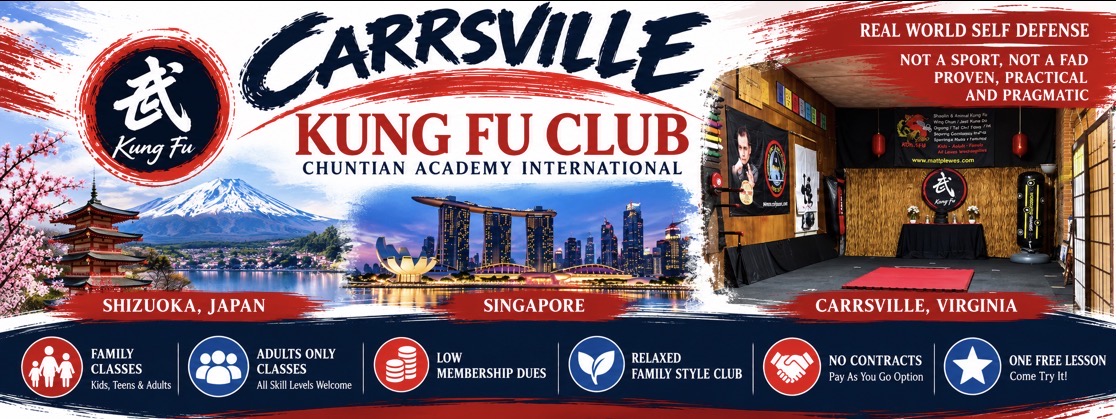
Matthew Plewes is a life-long practitioner, instructor, and researcher of real-world self-defense and traditional Asian martial arts. His training includes:
● 1976–1982: Seikukan Karate-do under Master Terumasa Ogawa
● 1984–2000: Five Animal Kung Fu and Chin’na under Master Samuel Cheeks, earning Junior Instructor status after 5 years and Master Teacher Certification after 17 years
● 1995–1997: Wing Chun and Jeet Kune Do under Art Wong
● 1996–1999: Yang Style Tai Chi Chuan and Qigong under Master Li Sun, a member of the Shanghai Tai Chi Association
Plewes founded Chuntian Academy in 1985 as a senior student under the guidance of Master Samuel Cheeks. After spending 22 years in Japan teaching, researching, and refining practical self-defense systems, he has returned to the United States. His experience spans 25 years in America and 22 years in Asia.
Chuntian Academy International (CAI)
CAI specializes in practical, non-sport, kung fu-based self-defense. The system combines proven traditional martial arts, close-range Hong Kong Kung Fu, and modern defense concepts drawn from police and military training.
CAI training emphasizes:
● Natural reflexes and body mechanics
● Effective techniques that do not rely on strength
● Realistic scenario-based training
● Violence prevention, awareness, and control tactics
● Functional self-defense for everyday situations
Students train for realistic encounters that may occur in streets, parking lots, public transportation, restaurants, homes, vehicles, and other common environments. CAI methods are designed for rapid response, efficient control, and practical application under stress.
Improvised Self-Protection Weapons
Unlike many traditional martial arts that focus on historical weapons, CAI teaches the practical use of everyday objects for self-defense. Items such as pens, keys, umbrellas, canes, magazines, chairs, and even footwear can become effective defensive tools when used properly.
Rank Progression
● 1988 – Assistant Instructor / 1st Rank
● 1990 – Junior Instructor / 2nd Rank
● 1992 – Instructor / 3rd Rank
● 1994 – Teacher / 4th Rank
● 1998 – Full Teacher / 5th Rank
● 2001 – Master Teacher / 6th Rank
● 2005 – Master / 7th Rank
● 2012 – Grandmaster / 8th Rank and Generational Lineage Leader
CAI’s mission is simple: teach intelligent, practical, and effective self-defense for the modern world through a fusion of traditional martial arts wisdom and contemporary defensive tactics.
WHAT IS SHAOLIN 5-ANIMAL KUNG FU
Kung Fu was first recorded in 525 AD and continues to be part of many martial arts training programs today. “Kung” means energy, and “fu” means time. It is credited to an Indian monk who originally introduced it. Kung Fu is comprised of 18 movements that were taught at the Shaolin temple to develop and build a strong body that would prevent the temple watch guards from falling asleep as they meditated.
The 18 hands are known to have originated in the Himalayas and are designed for daily practice and to strengthen and improve the health of those training. These movements continued to develop as the techniques and teachers of Kung Fu created new systems beginning with the basic foundations of the art.
The division of martial art into five different styles is based on animals because each animal is unique and compliments the other animal but has its own style and strengths. The Five Animal Style includes the dragon, tiger, crane, leopard, and snake. Masterfully incorporating both soft and hard movements while using external energy and internal as well, this form of Chinese martial arts became known as Shaolin Kung Fu.
In 1644, the Shaolin temple was destroyed, and the monks who resided there fled and continued to teach Kung Fu in their new locations. Naturally, slight modifications of the martial arts style evolved as each monk emphasized what they specialized in and were able to teach exceptionally. As the tradition of Kung Fu carried on, some changed the name to include the one responsible for spreading the techniques, and this is where we get style names like Bruce Lee Kung Fu and Jackie Chan Kung Fu.
THE FIVE ANIMAL TECHNIQUES
The dragon techniques of kung fu are designed to include flexibility and grace of movement. These techniques, cultivating the dragon’s spirit, emphasize the animal’s flowing spirit and honor its mythical associations. Displaying courage and energy in movement, when someone is moving like a dragon in kung fu, a natural flow, like a dragon’s tail, should be evident.
The tiger techniques and movements are explicitly designed to strengthen the bones within the body. Known as a combat-level martial art, it often uses hand weapons, unyielded force, and full power to emulate the ferociousness of tigers. Tiger kung fu is used in combat and battlefield training. As is true of a tiger in the wild, the kung fu style teaches how to fight multiple opponents with lethal intent.
The crane technique in kung fu strengthens the ligaments and promotes life and spirit in vitality. With a strong emphasis on balance and swift foot movement, the kung fu crane technique is methodical and focused during movements. The movements involved with crane kung fu mimic how a crane defends itself, using its beak, legs, and wings. Crane kung fu is considered a softer style and focuses on hitting pressure points.
The leopard is all about power, speed, and developing strength. Using hand techniques to overcome an opponent, the leopard style demands fast footwork and movement to produce force. Some say the leopard is a blend of the crane and tiger kung fu styles. Drawing from the tiger’s sheer strength and the crane’s agility, the leopard does not crush as a tiger would but uses short-range and fast whip-style techniques.
The snake kung fu style training is directed at cultivating Chi. A strong emphasis and focus on breathing and strengthening internal power through breathing allows those using snake kung fu to strike vulnerable areas with focus and targeted energy drawn from the inner strength. Imitating the fluidity of a snake, training includes hitting from unexpected angles and catching opponents off guard. Snake kung fu is also considered a soft or slow style, but it is as effective as the others.
THE BEST OF KUNG FU
Kung fu history is rich with tradition. As Shaolin Kung Fu developed and expanded in the direction of the monk teaching it, kung fu continues to evolve today. Five Animal Kung Fu was established and continues to be taught throughout the world. Some schools may specialize in a particular style or animal of kung fu, but few kung fu schools find ways to appeal to a broader audience. Schools like us (CAI) use a combined approach, allowing students to experience and learn the best of all the five animal styles.
Our Ranking System
CAI Ranking System
The CAI ranking system is unique to our organization and is based on training completion, skill development, attitude, maturity, character, and overall progress.
Ranks serve two purposes:
1. To recognize and reward student achievement.
2. To help instructors quickly identify a student’s training level in larger classes.
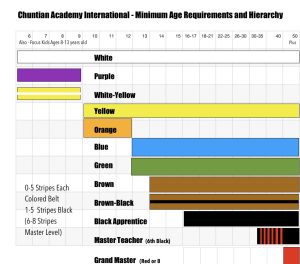
Our colored sash system uses nature-based metaphors to represent a student’s growth and development. Each rank contains five internal levels, represented by stripes. For example, a student may hold the rank of Green Sash, 3rd Stripe.
Foundation Training
All long-term students begin each class with approximately 20 minutes of foundational training including:
* Temple Exercises
* Tai Chi
* Qigong
* Eight Brocades (Ba Duan Jin)
* Punching, Blocking, and Kicking Drills
* Two-Person Reaction and Response Training
⸻
White Sash – Winter
Symbolism: Winter snow protecting newly planted seeds.
Training Focus:
* Basic Escape And Run (B.E.A.R.)
* Fundamental self-defense
* Escape from grabs, holds, and common attacks
* Awareness and avoidance
Long-term students also begin learning Lohan Shiba Shou (Shaolin 18 Hands/Fist Form).
Reward: Yellow Sash and B.E.A.R. Program Patch.
⸻
Yellow Sash – Early Spring
Symbolism: The warming sun melts winter snow and awakens new growth.
Training Focus:
* Wu Bu Quan (Five Stance Form)
* Mobility and body mechanics
* Intercepting techniques
* Joint locks and control methods
* Non-lethal restraint tactics
This level emphasizes practical control skills valuable for civilians, security professionals, and law enforcement personnel.
⸻
Blue Sash – Spring Rain
Symbolism: Water nourishes the growing seed.
Training Focus:
* 16 Chang Form
* Defense against fast punches and kicks
* Evasion and counterattack methods
* “Looser” training drills emphasizing movement, protection, and escape
Students begin studying the practical applications of forms and techniques through extensive drills and repetition.
⸻
Green Sash – Growth
Symbolism: The seed has become a strong growing plant.
Training Focus:
* S.A.C.T. (Seize and Control Tactics)
* Pressure points and body mechanics
* Control and neutralization methods
* Advanced self-defense applications
Students begin to understand the principles of simplicity, efficiency, and refinement.
Reward: S.A.C.T. Program Patch.
⸻
Brown Sash – Autumn
Symbolism: Falling leaves represent discarding unnecessary techniques, ego, and poor habits.
Training Focus:
* Weapons awareness and defense
* Multiple-opponent survival
* Life-threatening encounter management
* Instructor preparation
Students begin intensive study of the Five Animal System:
* Dragon
* Tiger
* Snake
* Crane
* Leopard
Mastery of these concepts provides deeper understanding of all previous training.
⸻
Black Sash – Apprentice Teacher
Black Sash (No Stripe)
Students begin the transition from student to instructor.
Training Focus:
* Teaching lower ranks
* Advanced physical training
* Tai Chi
* Qigong
* Meditation
* Leadership development
The goal is to develop balanced martial artists capable of guiding others.
⸻
Black Sash – 1 Stripe
Knowledge and proficiency in approximately 80 of the 108 core techniques.
Promotion determined by the Head Master.
⸻
Black Sash – 2 Stripes
Knowledge and proficiency in approximately 100 of the 108 core techniques.
Promotion determined by the Head Master.
⸻
Black Sash – 3 Stripes
Knowledge and proficiency in all 108 core techniques.
Promotion determined by the Head Master.
⸻
Black Sash – 4 Stripes
Demonstrated expertise in all 108 techniques, teaching ability, and personal maturity.
Promotion determined by the Head Master.
⸻
Black Sash – 5 Stripes
Completion of all technical student requirements.
This rank signifies recognition as a Full Teacher. The individual is expected to continue teaching, researching, and developing throughout life.
⸻
Honorary Master Levels
Master ranks are awarded based on years of service, teaching success, leadership, and contribution to future generations.
Black Sash – 6 Stripes
Master Teacher
Minimum 10 years as a Full Teacher and successful development of a student from White Sash to Black Sash.
Black Sash – 7 Stripes
Associate Master
Awarded after a second student is successfully guided from White Sash to Black Sash.
Black Sash – 8 Stripes
Grandmaster
Awarded to a senior master who has produced multiple generations of qualified instructors.
Black Sash – 9 Stripes
Senior Grandmaster
A unique organizational position awarded only through succession and generational leadership.
Black Sash – 10 Stripes
Highest Living Rank
The highest active rank within the organization.
11th Degree and Above
Reserved as honorary recognition for deceased masters and founders whose contributions continue to influence future generations.
⸻
Junior and Children’s Programs
Junior Program (Ages 10–16)
Additional ranks:
* Orange Sash (between Yellow and Blue)
* Red Sash (between Brown and Black)
These ranks allow younger students more time to develop physically and emotionally before advancing.
Children’s Program
Lil’ Dragons (Ages 4–6)
Lil’ Tigers (Ages 6–9)
Children’s programs include four additional developmental ranks:
* Two Yellow Levels
* Two Blue Levels
These extra levels provide smaller achievement steps, helping younger students build confidence, discipline, and long-term success.
Below is Our typical Ranking System
List of Terms
Kuen – Boxing or Fist
Hoi Ma – Opening the stance
Yee Jee Kim Yeung Ma – Neutral/Centered Stance (See the Wing Chun stance)
Do Ma – Knife stance (Forward Stance)
Kwan Ma – Pole stance (Wide Horse)
Doi Gok Ma – Side/Turned stance
Juen Ma – Turning stance
Bil Ma – Advancing stance
Joan Sien – Centerline
Sifu – Teacher
Sigung – Teacher’s Teacher
Sihing – Elder student
Sidai – Junior student
Kung Fu (Gung Fu) – Skill developed through hard work
Mook Yan Jong – Wooden Dummy
Hong Jong – Air dummy
Sao – Hand or Arm
Gerk – Foot or Leg
Chi Sao – Sticky Hands
Don Chi Sao – Single sticky hands
Seong Chi Sao – Double sticky hands
Poon Sao – Rolling Arms
Chi Gerk – Sticky Legs
Tan Gerk – Knee Turned Out Leg
Bong Gerk – Knee Turned In Leg
Goang Gerk / Gaan Gerk – Splitting Leg
Pak Gerk – Slapping Leg
Chung Choi – Chain Punches (Lin Wah Kuen)
Chung Kuen – Sun Fist Vertical Punch
Tan Sao – Palm up hand (Dispersing hand)
Goang Sao – Splitting Arm
Fook Sao – Controlling Arm
Bong Sao – Wing Arm / Elbow out arm
Dai Bong Sao – Low Wing Arm
Wrong Bong Sao – Crossing Bong Sao
Jow Sao – Inside- to outside-line hand
Man Sao – Inquisitive Hand / Jamming Hand
Wu Sao – Protective Hand
Pak Sao – Slapping Hand
Fak Sao – Whisking/Swinging Arm
Toy Sao (Tok Sao) – Lifting Hand
Jum Sao – Sinking hand
Mut Sao – Lowering hand
Huen Sao – Circling Hand
Bil Sao – Knife Arm / (Type of Palm Strike)
Gum Sao – Pinning Hand
Chin Gum Sao – Front Gum
How Gum Sao – Back Gum
Ju Gum Sao – Side Gum
Lan Sao – Barring Arm
Jut Sao – Jerking Arm
Lop Sao – Grabbing Hand
Chang Sao – Spade Hand
Mang Geng Sao – Neck Pulling Hand
Shat Geng Sao – Throat Cutting Hand
Scissors Goang Sao – Upper and Lower Goang Sao
Kwan Sao – Rotating Arms (low bong sao and tan sao)
Powl Sao – Turning Bong Sao
Kao Sao – Zoning Hand
Phon Sao – Trapping Hands
Jeet Sao – Intercepting Hands
Chin-Na – Locking, seizing, and controlling
Kwai Jeong – Butting Elbow
Pie Jeong – Hacking Elbow
Butt Doan Jeong – Immovable Elbow
Luk Sao – Flowing drill (Element of Sparring)
Nuk Sao – Free Sparring
Gow Sao / Gwo Sao – Sparring out of from Seong Chi Sao (Poon Sao) / (aka Fighting practice)
Lat Sao – Free form training
Pa Da – Fear of being hit
Dwai Da – Fear of hitting
Tom Da – Greedy to hit
Kwan – Pole
Do – Knife
Luk Dim Boon Kwan – Dragon Pole
Baat Jam Do – Butterfly Knives
Sam Pie Fut – “Three Prayers to Buddha” (from Sil Lim Tao form)
Sam Sing Sao – Hitting the 3 stars hands (drill)
Huen Ma – Circling Steps (Horse)
Huen Got Sao – Circling cut (turning Huen Sao)
Po Pie – Embracing the Edges
Gnoy – Outside
Gnoy Pak Sao – Outside Pak Sao
Gnau – Wrist
Jee – Finger
Jeong – Elbow
Mai Jeong – Elbow Position
Jung Dao – Head up, chin tucked
Ting Yiu – Straight lower back (Spine anchored to the ground (pelvis tilted, coccyx tucked under)
Kim Sut – Pinching the Knees (Constant pulling together of the thighs)
Lok Ma – Lowering the stance (Connecting to the ground)
Lik – Power, Force, or Energy
Mok Lik – Targeting your gaze
Lower Tan Tien – Energy storage place in lower belly
Kung Fu Terminology
Many of Wing Chun’s terms are general Kung Fu terms used in many other types of Chinese martial arts. Here are some of these Kung Fu terms.
Founder: Si-Jo: Lee-Banks-Cheeks-Plewes
Teacher’s teacher: Si-Gung (Sam Cheeks)
Older Gung Fu Uncle: Si-Baak (Grant, Washington)
Teacher: Sifu * Matthew Plewes
Teacher’s Wife: Si-Mou * Juli
Older Brother: Si-Hing, Si-Go
Younger Brother: Si-Dai
Student: Dai-Ji, Tou-Dai (Man,Wonan)
Student’s wife: Tou-Sik
Student’s Student: Tou-Syun
In Door Student: Yap-Sat-Dai-Ji
Lineage Holder: Jeung-Mun, Jeung-Mun-Yan (
Kung Fu School: Kwoon
1986-2009 History Below
Photos
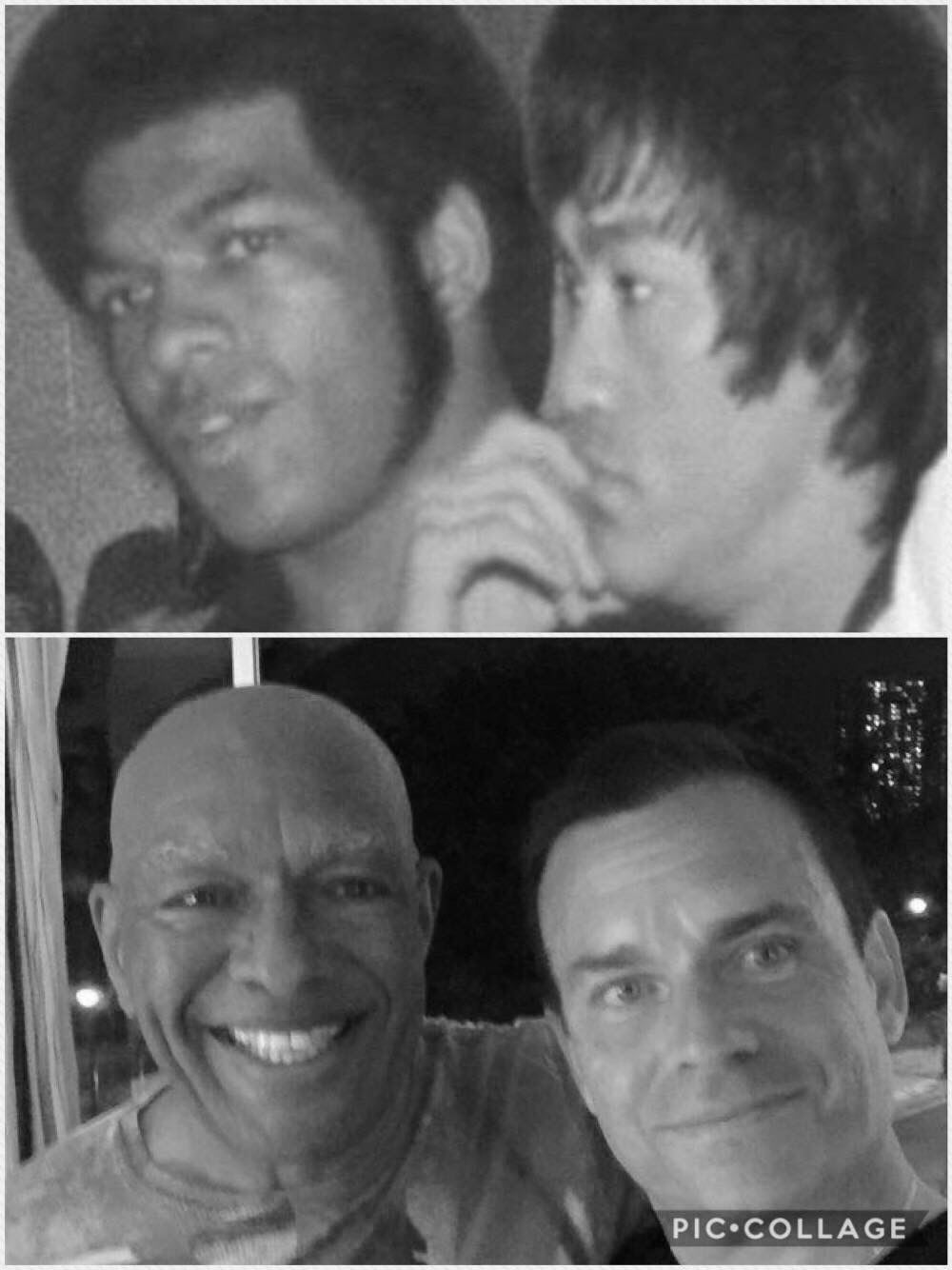
Ron “The Black Dragon” Van Clief with Bruce “The Dragon” Lee (Top), Ron “The Black Dragon” Van Clief with Chuntian Academy Founder Matthew Plewes.
https://www.blackdragonfan.com (Fan Site)
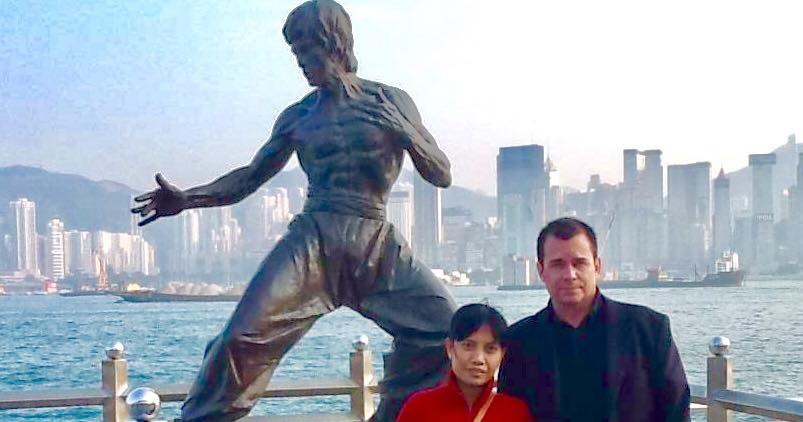
Matt Plewes and wife visiting the Bruce Lee statue in Hong Kong..
カンフーは、西暦 525 年に最初に記録され、今日も多くの武術トレーニング プログラムの一部となっています。 「カン」はエネルギー、「フー」は時間を意味します。 それを最初に紹介したインドの僧侶の功績によるものです。 カンフーは少林寺で教えられた 18 の動きで構成されており、寺院の警備員が瞑想中に眠りにつくのを防ぐための強い体を発達させ、構築します。
18本の手はヒマラヤに由来することが知られており、毎日の練習と、トレーニングの健康を強化および改善するために設計されています. これらの動きは、King Fu の技術と教師が芸術の基本的な基礎から始まる新しいシステムを作成するにつれて、発展し続けました。
格闘技を 5 つの異なるスタイルに分類するのは、動物に基づいています。それぞれの動物はユニークで、他の動物を補完しますが、独自のスタイルと強みを持っているからです。 五獣とは、龍、虎、鶴、豹、蛇のこと。 外部エネルギーと内部エネルギーを使用しながら、ソフトとハードの両方の動きを巧みに取り入れたこの形式の中国武術は、Shaolin Kung Fuとして知られるようになりました.
1644 年に少林寺が破壊され、そこに住んでいた僧侶たちは逃げ出し、新しい場所でカンフーを教え続けました。 当然のことながら、各僧侶が自分の専門分野を強調し、例外的に教えることができるようになるにつれて、武道スタイルのわずかな修正が進化しました. カンフーの伝統が引き継がれるにつれて、名前を変更してテクニックを広める責任者が含まれるようになり、ブルース・リー・カンフーやジャッキー・チェン・カンフーなどのスタイル名が付けられました.
5つの動物技術
カンフーのドラゴン テクニックは、柔軟性と優雅な動きを含むように設計されています。 ドラゴンの精神を育むこれらの技術は、動物の流れる精神を強調し、その神話的な関連性を尊重します。 誰かがカンフーのドラゴンのように動いているとき、ドラゴンの尾のような自然な流れが明らかであるべきです.
トラのテクニックと動きは、体内の骨を強化するように明確に設計されています. 戦闘レベルの武術として知られており、手武器、不屈の力、全力を駆使して虎の獰猛さを模倣することがよくあります。 タイガー カンフーは、戦闘や戦場での訓練に使用されます。 野生の虎と同様に、カンフー スタイルは、複数の敵と致命的な意図で戦う方法を教えます。
カンフーのクレーン技術は靭帯を強化し、生命と精神の活力を促進します。 バランスと素早い足の動きに重点を置いたカンフー クレーン テクニックは、整然と動きに集中します。 鶴カンフーの動きは、鶴がくちばし、脚、翼を使って身を守る方法を模倣しています。 クレーンカンフーはよりソフトなスタイルと考えられており、ツボを打つことに重点を置いています。
ヒョウは、パワー、スピード、強さの発達がすべてです。 ヒョウ スタイルでは、ハンド テクニックを使用して相手を打ち負かし、力を生み出すために素早いフットワークと動きが要求されます。 ヒョウは鶴と虎のカンフー スタイルを融合させたものだと言う人もいます。 トラの純粋な強さとツルの敏捷性を利用して、ヒョウはトラのように押しつぶすのではなく、短距離で高速の鞭スタイルのテクニックを使用します。
ヘビカンフースタイルのトレーニングは、気の育成に向けられています。 呼吸に重点を置いて集中し、呼吸によって内部の力を強化することで、スネークカンフーを使用する人は、内部の強さから引き出された焦点と的を絞ったエネルギーで脆弱な領域を攻撃することができます. ヘビの流動性を模倣し、トレーニングには、予期しない角度からヒットし、敵を不意を突くことが含まれます。 スネークカンフーもソフトまたはスロースタイルと見なされますが、他のカンフーと同じくらい効果的です.
ベスト・オブ・カンフー
カンフーの歴史は伝統にあふれています。 少林寺カンフーが発展し、それを教える僧侶の方向に拡大するにつれて、カンフーは今日も進化し続けています. ファイブアニマルカンフーが確立され、全国で教えられ続けています。 一部のスタジオはカンフーを専門とする場合がありますが、多くの格闘技スタジオは、より幅広い視聴者にアピールする方法を見つけています. 私たちの学校は組み合わせたアプローチを使用しており、生徒は5つの動物スタイルすべてを体験して学ぶことができます.
Celebrating 45 Years! (1976-2021)