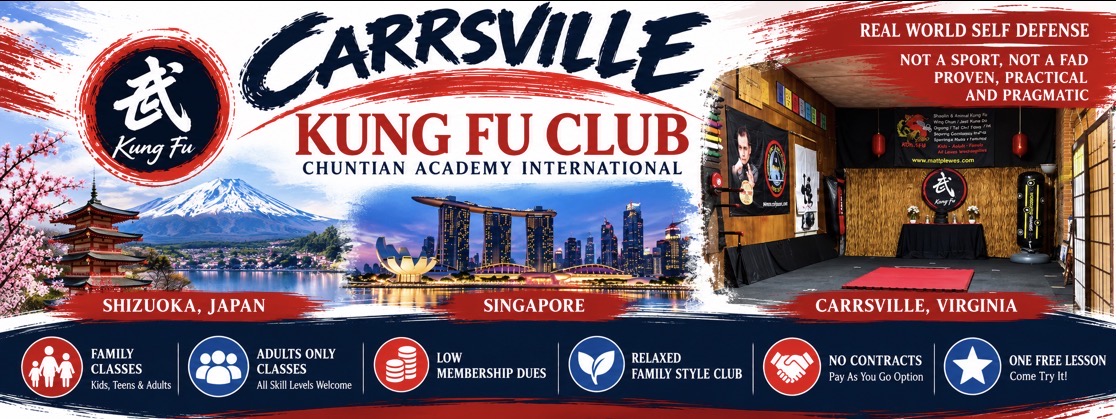
Chuntian Academy International (CAI)
Cheeks-Plewes Martial Arts Club – 1985 – 88
Founded: Chuntian Kung Fu Club -1988 -1997
Founded: Chuntian Academy – 1997-2001
Founded: Chuntian Academy International (CAI) – 2001- Present
Our Mission
Chuntian Academy International is a self-defense focused martial arts school rooted in traditional Chinese martial arts and adapted for modern realities.
Our focus is not on promoting a particular style, collecting trophies, chasing rank, or creating exaggerated martial arts legends. Martial arts today is largely unregulated, and claims of countless disciples, endless Hall of Fame titles, or inflated credentials are common. We prefer to let our training, experience, and results speak for themselves.
We are not a sport martial arts organization. We train for personal development, health, confidence, and practical self-defense. Our ranking system exists for internal student development and instructor reference only.
Throughout 22 years living and teaching in Japan, and additional work in Singapore, our methods were continually tested, refined, and proven through real-world application.
⸻
Our Lineage
Teacher’s Teacher’s School
Man-O-War Fighting Arts
Chief Teachers
* Nicholas Banks (1966–1975)
* Samuel Cheeks (1975–1985)
Primary System
Shaolin Wuxing Kung Fu (Five Animal Kung Fu)
Core Traditions
* Five Animal Forms
* Original 18 Luohan Hands
* Neigong
* Qigong
* Chin’na (Seize and Control)
Related Southern Chinese Arts
* Fujian White Crane
* Hung Ga
⸻
Historical Background
The Five Animal System traces its roots to Shaolin traditions and the development of Tiger, Crane, Leopard, Snake, and Dragon methods. According to traditional accounts, Shaolin practitioners expanded the original 18 Luohan techniques into a larger and more sophisticated fighting system that combined both external and internal training methods.
In the 1960s, Grandmaster Ho Lee brought his family’s Five Animal Kung Fu from Guangdong and Hong Kong to New Jersey. There he met Nicholas Banks, an Okinawan Shorinji practitioner and Vietnam-era serviceman. Recognizing a shared commitment to practical martial arts, the two began exchanging knowledge and training.
Banks eventually became one of Ho Lee’s leading students and taught neighborhood youth free of charge to build confidence, discipline, and positive alternatives to gangs and drugs. Advanced students received additional private instruction in the traditional Five Animal system.
In the early 1970s, Banks and several senior students relocated to Tidewater, Virginia to work at Newport News Shipbuilding during construction of the USS Nimitz. There, the Man-O-War Fighting Arts School was established.
Among its notable instructors were:
* James “Juju” Washington
* Lee Grant
* Samuel Cheeks
After the shipbuilding project ended, many students returned north, but Samuel Cheeks remained in Virginia and continued teaching.
⸻
Matthew Plewes and Chuntian Academy
In 1984, Samuel Cheeks accepted Matthew Plewes as a private student. After years of intensive training, Plewes became a certified system instructor and later a full Master Teacher in the lineage.
During the late 1980s, Cheeks and Plewes opened the Cheeks-Plewes Martial Arts Club, allowing Plewes to develop as an instructor under direct supervision while continuing private training.
When Samuel Cheeks retired in the early 1990s, he authorized Matthew Plewes to continue teaching and preserving the system. Plewes subsequently founded Chuntian Martial Arts Club.
During the same period, Plewes studied:
* Wing Chun fundamentals under Art Wong (Norfolk, Virginia)
* Jeet Kune Do concepts
* Escrima and Filipino weapon systems
Wing Chun’s highly refined blocking and sensitivity drills were integrated into the curriculum to strengthen defensive skills, while Jeet Kune Do concepts encouraged adaptability, efficiency, and continual growth.
⸻
Modern Development
In 1997, Plewes opened Chuntian Academy’s commercial and research school in Suffolk, Virginia. Active law enforcement officers, military personnel, and corrections professionals contributed practical feedback that helped refine the modern self-defense applications of the system.
Chin’na control techniques were evaluated through real-world use by police and correctional officers.
From 1998–1999, Plewes studied Tai Chi Chuan and Qigong under Li Sun, a member of the Shanghai Taichiquan Association. These health, breathing, and longevity practices became a permanent part of CAI training and remain incorporated into classes today.
⸻
Japan and International Expansion
In 2001, Plewes traveled to Japan intending to stay six months while researching Japanese martial arts. After the events of September 11, 2001, he extended his stay.
Following several public demonstrations of practical self-defense, local residents encouraged him to teach. What began as a small class quickly expanded into multiple locations throughout Shizuoka Prefecture.
Plewes was later featured on Japanese television and taught at the SBS Television Training Center for more than a decade.
As the school expanded, Chuntian Academy International (CAI) was formally established to reflect its international presence.
For the next 22 years, Plewes taught, researched, and refined the curriculum throughout Japan while raising a family and building a strong martial arts community.
In 2023, he returned to Virginia and began establishing a new generation of clubs and programs.
⸻
The CAI Method
Chuntian Academy International is best described as a Kung Fu-based school rather than a single-style organization.
Our curriculum combines:
* Traditional Five Animal (Wuxing) Kung Fu
* Original Shaolin training principles
* Wing Chun defensive concepts and drills
* Chin’na control and restraint methods
* Jeet Kune Do concepts of adaptability and efficiency
* Modern self-defense applications
* Tai Chi, Qigong, and longevity practices
We preserve traditional knowledge while remaining open to improvement and practical application.
Our goal is simple:
Train honestly. Train effectively. Preserve what works. Continue learning.